
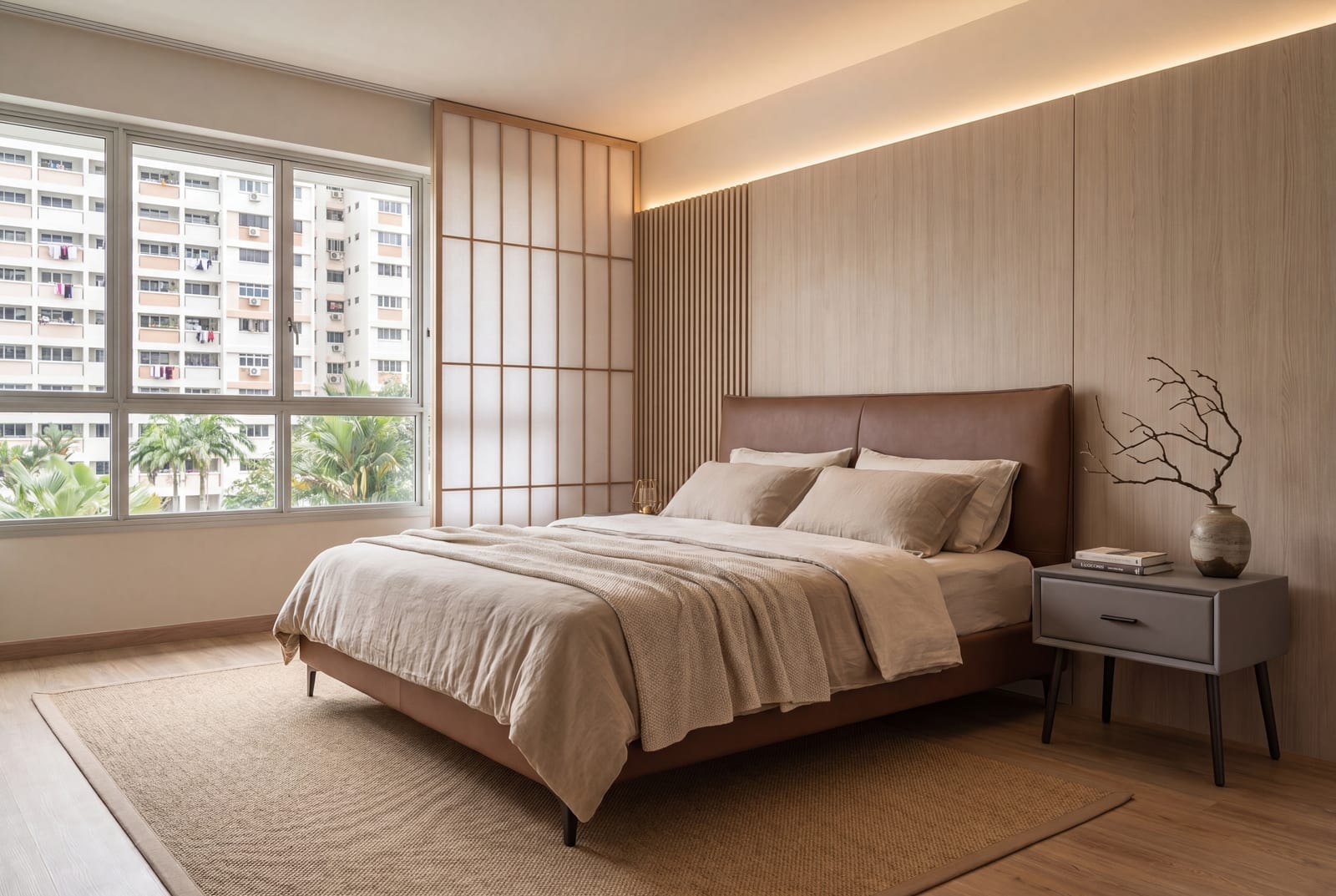
In many HDB flats, the space under the bed is the biggest storage area nobody is using. A storage bed puts it to work: luggage, spare bedding, the clothes you only need once a year. The real question is how you get into it. There are two main designs. Lift-up beds raise the mattress platform on gas struts and are usually sold as hydraulic beds. Drawer beds slide storage out from the sides or the foot. Each suits a different bedroom, and a different kind of stuff.
How each type works
Lift-up beds (hydraulic or gas-strut)
The mattress sits on a platform that lifts to reveal one large storage cavity underneath. Struts, much like the ones that hold up a car boot, take most of the weight, so you raise it by a strap or handle rather than heaving the mattress yourself. Strictly speaking, most use gas struts rather than hydraulics, but "hydraulic bed" is the name that has stuck.
There are two common ways the platform opens:
- End lift: the base tilts up from the foot of the bed, hinged towards the headboard. You stand at the foot and reach in.
- Parallel lift: the whole platform rises level, so the cavity opens along its full length and you can reach in from the sides as well as the foot.
Drawer beds
Drawer beds have drawers built into the sides or the foot of the base, running on rails. You get at your things without touching the mattress, which makes drawers the better fit for everyday items like clothes, towels or toys. The trade-off is that drawers only reach in from the edges, so the middle of the space under the bed often goes unused.
Clearance: the deciding factor in most HDB bedrooms
This is where the two types differ most, and where many HDB bedrooms make the decision for you. A drawer needs clear floor in front of it equal to its own depth, plus room for you to stand or kneel while you reach in. A lift-up bed opens upwards, so it needs little floor beyond what you'd leave around the bed anyway.
Our furniture clearance guide suggests about 60 cm beside the bed as a rule of thumb, so you can get in and out and make the bed comfortably. That 60 cm is for walking. It isn't automatically enough to pull a drawer all the way out and kneel in front of it, especially with a bedside table or a wardrobe door nearby. Before you choose, check:
- Is one side of the bed pushed against a wall? Drawers on that side are unusable, so you'd need drawers on the open side or at the foot.
- Do wardrobe doors swing into the space beside the bed? A drawer and a wardrobe door can't both be open at once.
- Will a bedside table sit where a drawer opens? Check where the drawers actually sit along the frame.
- For an end lift, is there room to stand at the foot of the bed? For a parallel lift, can you reach in from at least one side?
| If your bedroom has… | Lift-up (hydraulic) | Drawers |
|---|---|---|
| The bed against a wall on one side | Works: opens upwards, reach in from the open side or the foot | Only drawers on the open side or the foot are usable |
| About 60 cm or less beside the bed | Works | Often too tight to pull out and kneel |
| A wardrobe right beside the bed | Works | Drawers and wardrobe doors compete for the same floor |
| Clear floor at the foot of the bed | Suits an end lift | Suits drawers at the foot |
What fits inside
A lift-up bed gives you one big, open cavity across most of the bed's footprint. It's ideal for things that are bulky, or that you only need now and then: suitcases, spare duvets and pillows, out-of-season clothes, festive decorations, a folded mattress topper.
Drawers hold less but are quicker to reach. They suit things you use every week and want sorted: folded clothes, linen sets, shoes, toys. If you'll be opening the storage daily, drawers are kinder. Lifting a mattress platform to fetch one T-shirt soon wears thin.
Weight and everyday handling
With a lift-up bed you're raising the mattress every time you open it. Good struts make that feel light, but the heavier the mattress, the more they have to do, so ask the seller whether the lift suits your mattress before you order. You'll also want to clear anything heavy off the bed first, and it's awkward with someone still lying on it.
Drawers open easily on their own, though a fully loaded drawer can drag as its rails wear. With either type, keep small children from climbing into an open cavity or standing on an open drawer.
Ventilation and mould
Both designs create an enclosed space under the mattress, and in Singapore's humidity that deserves a little attention. Drawers get opened often, which lets air in as a matter of course. A lift-up cavity can stay shut for months, so make a habit of lifting the base every few weeks and letting it air.
- Store linens and clothes only once they're completely dry.
- Use breathable fabric storage bags rather than sealed plastic tubs.
- Put a moisture absorber in a corner and replace it when it's full.
- Leave a small gap between the bed and the wall so air can move.
Our guide to preventing mould on furniture covers the full wet-season routine for beds and under-bed storage.
Cost
Storage adds to the price of a bed frame either way, because there's more mechanism and more structure. Drawer beds need drawer boxes and rails; lift-up beds need a hinged or lifting platform and struts. Prices vary widely between makers, so compare like for like: the frame, the storage, and delivery and installation, added together.
How storage works on our bed frames
We don't offer drawer beds. Instead, selected bed frames in our range offer an optional lift-up storage base, which you choose on the product page under Under-bed storage. There are two types:
- Parallel lift, +$150: raises the whole mattress platform level.
- End lift, +$100: hinges the base up from the foot of the bed.
Leave it on None if you don't need storage. If you add a lift, it appears as its own line at checkout. If your mattress is particularly heavy, ask us before you order whether the lift suits it. Our bed frames come in Super Queen and Super King, each in a version for 200 cm-long mattresses and one for 190 cm-long mattresses, with real dimensions for every size on the product page. Like everything we sell, they're delivered and installed by our team.
The Leilo pairs a top-grain leather headboard with a solid wood frame and a steel and wood slat base, and offers both lifts. The Talin stands 120 cm tall at the headboard, which is generously padded with top-grain leather on its contact surfaces, and offers both too. Not every frame has the option, so look for Under-bed storage on the product page.
See the Talin bed frame →Browse our bed frames →Quick checklist before you choose
- Measure the clear floor on each side and at the foot of the bed, with the wardrobe doors open.
- Decide what you'll store. Everyday items lean towards drawers; bulky, seasonal things lean towards a lift.
- If you go lift-up, choose end or parallel based on where you can stand to reach in.
- Check the bed size against the room. Our queen vs king guide walks through typical HDB bedroom sizes.
- Plan bedside tables around the storage, not in its way. Our side tables list their real dimensions.
- Plan a simple airing routine so the storage stays fresh.
Storage beds: common questions
- Is a hydraulic or drawer storage bed better for a small HDB bedroom?
- Usually a hydraulic (lift-up) bed, because it opens upwards and doesn't need clear floor beside the bed for drawers to slide out.
- How much space do I need beside a drawer bed?
- Enough for the drawer's full depth plus room to kneel in front of it. That's often more than the roughly 60 cm suggested for walking beside a bed.
- Are hydraulic storage beds hard to lift?
- Struts take most of the weight, so a good lift feels light. A heavier mattress asks more of them, so check with the seller that the lift suits yours.
- What's the difference between a parallel lift and an end lift?
- A parallel lift raises the whole mattress platform level. An end lift tilts the base up from the foot of the bed, hinged towards the headboard.
- Do storage beds get mouldy in Singapore?
- They can, because the space underneath is enclosed. Air it every few weeks, store only dry items and keep a moisture absorber inside.
- Can I add storage to a Vella bed frame?
- On selected frames, yes: an optional parallel lift (+$150) or end lift (+$100), chosen under Under-bed storage on the product page.