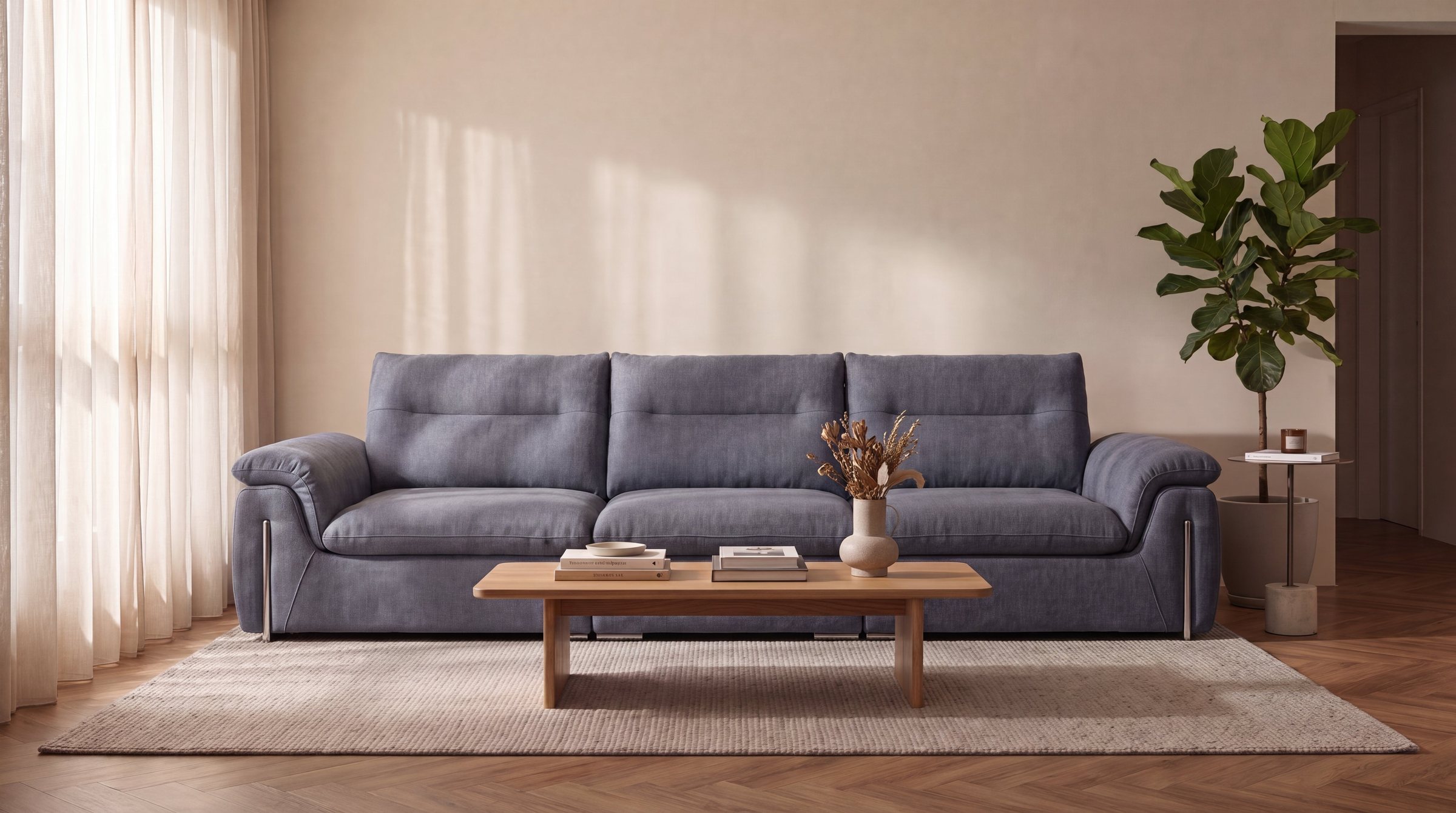
Two sofas can share the same length and still feel completely different to sit on. One keeps you upright with your feet on the floor; the other invites you to tuck your legs up and stay for the evening. Most of that difference comes down to two numbers that are easy to overlook: seat depth and seat height. Here's what they mean, the usual ranges in centimetres, and how to match them to your height and the way you actually sit.
Four measurements, and what each one tells you
Product pages don't all use the same words, so it helps to know exactly what each measurement is.
- Overall depth: from the very front of the sofa to the back of its frame. This is the number for floor planning, because it's how far the sofa reaches into the room.
- Seat depth: from the front edge of the seat cushion to where the back cushions begin. This is the number for comfort. It's always noticeably less than the overall depth, because the back frame and cushions take up part of it, and how much they take varies a lot between designs.
- Seat height: from the floor to the top of the seat cushion. It decides whether your feet rest flat and how easy it is to stand up.
- Back height: usually given as the overall height, from the floor to the top of the back. It decides whether the sofa supports your shoulders and head, and how much of the room it hides.
Many listings, including most of ours, give the overall width, depth and height. Seat depth and seat height aren't always listed separately, so when they aren't, ask the seller. They're the most useful comfort numbers you can have, and they take a minute to get.
Seat depth: deep seat sofa vs standard
As a rough guide, most sofas fall into one of two camps.
| Standard seat | Deep seat | |
|---|---|---|
| Seat depth (rough guide) | About 50–60 cm | About 60 cm and up |
| How it sits | Upright, back against the cushions, feet on the floor | Laid-back, with room to curl up, sit cross-legged or lie across it |
| Suits | Reading, chatting, a laptop on your knees, older family members | Movie nights, lounging, taller people, anyone who sits with their legs up |
| Watch out for | Can feel shallow if you're tall or like to lounge | Shorter people may not reach the back with their feet on the floor |
The quickest test is to sit all the way back. If your knees bend comfortably at the front edge of the cushion, with a few fingers' gap between the edge and the back of your knees, the depth suits you for upright sitting. If the edge presses into the back of your knees, the seat is deeper than you need. If your thighs hang well past the front, it's too shallow.
Sofa seat height: why a few centimetres matter
Seat heights commonly sit around 40–48 cm. Lower seats feel relaxed and look sleek, especially on a long, low sofa. Higher seats are easier to get in and out of.
Aim for a height where your feet rest flat on the floor and your knees sit roughly level with your hips. If the sofa will be used by parents or grandparents, or anyone with sore knees, a higher, firmer seat will be used far more happily than a low one they have to push themselves out of.
Seat height also sets the height of your coffee table, which works best within a few centimetres of the seat. Deep, low sofas pair well with lower coffee tables; our coffee table size guide has the details.
Back height and how it changes the look
A low back reads lighter and keeps a room's sightlines open, which helps in a compact living room or when the sofa floats in the middle of a space. A higher back supports your shoulders and sometimes your head, which suits anyone who naps on the sofa or sits upright to watch TV. Overall height is a good guide here: in our range, the Cubex sits low at 60 cm overall, while the Rirun stands 90 cm high.
Which seat suits your height?
There's no exact formula, but body height is a reasonable starting point, because leg length tends to follow it. Use this as a guide, then adjust for how you like to sit.
| Your height | Seat depth to look for | Seat height to look for | Good to know |
|---|---|---|---|
| Under about 160 cm | About 50–55 cm | About 40–43 cm | A deeper sofa can still work with a firm lumbar or back cushion |
| About 160–175 cm | About 53–60 cm | About 42–46 cm | Most standard sofas suit; go deeper if you like to lounge |
| Over about 175 cm | About 58 cm and up | About 44–48 cm | A deeper seat supports your thighs; a higher back supports your head |
And by the way you sit
| How you sit | What to look for |
|---|---|
| Upright: reading, chatting, a laptop on your knees | A standard depth, a firmer seat and a back that reaches your shoulders |
| Lounging: legs tucked up, sitting sideways | A deep seat of 60 cm or more, with soft back cushions |
| Lying down for naps | Length first (seating between the arms at least as long as you are tall, unless you're happy to rest your head on an arm), then depth |
| A mixed household, short and tall | A deep seat with loose back cushions you can add or remove, or an adjustable backrest |
Choosing a sofa for short people
If you're on the shorter side, the usual frustration is a deep sofa that leaves your feet dangling or your back unsupported. Look for a seat depth in the low 50s (in centimetres) and a seat height around 40–43 cm. If you've fallen for a deeper sofa anyway, you don't have to give it up: a firm lumbar cushion or a second row of back cushions brings the back forward to meet you.
Choosing a sofa for tall people
Taller people tend to find standard sofas shallow, with their thighs unsupported and their head well above the back. A seat depth from the high 50s upward, a seat height in the mid-40s and a higher back all help. Check the length too: if you like to lie down, the seating between the arms matters more than the overall width.
Adjustable seats: one sofa, two depths
Some sofas let you change the depth instead of choosing one. Our Ribus has a backrest that moves forward and back; its product page lists a seat depth of 60 cm with the backrest forward and 90 cm with it back, within an overall depth of 120 cm. The Tinoa goes further, with a seat that extends electrically by remote, from 65 cm to 115 cm deep; its overall depth is 110 cm closed and 160 cm open. For a household where one person sits upright and another lounges, that settles the argument.
See the Ribus sofa and its adjustable backrest →Making a deep sofa work: cushion tips
- Add a lumbar cushion. A firm rectangular cushion behind your lower back effectively shortens the seat by several centimetres.
- Layer the back cushions. Two rows, a larger cushion behind and a smaller one in front, turn a lounging depth into an upright one. Take the front row away for movie night.
- Prefer firmer seat cushions for upright sitting. A soft seat lets you sink back further, which makes a deep sofa feel deeper still.
- Use a footstool. If your feet don't reach the floor comfortably, a footstool or ottoman turns a deep seat into a lounger instead of a struggle.
- Keep the coffee table within reach. You'll sit further back on a deep sofa, so a table at the usual distance can feel far away.
How to check before you buy online
- Measure a sofa you already find comfortable: seat depth, seat height and overall height. It's the best reference you have.
- Compare it with the listing, and ask for the seat depth and seat height if only overall dimensions are given.
- Check the overall depth against your room, leaving legroom in front and a walkway where people pass. Our furniture clearance guide has the numbers.
- Think about everyone who'll sit on it, not just you.
Every sofa on our sofas page lists its overall width, depth and height for each size, so you can compare them with the sofa you already know.
Browse our sofas →Sofa seat depth and height: common questions
- What is a good seat depth for a sofa?
- As a general guide, about 50–60 cm is standard and suits most people for upright sitting. Deep seats of 60 cm or more suit lounging and taller people.
- What is a standard sofa seat height?
- Seat heights commonly fall around 40–48 cm, measured from the floor to the top of the seat cushion. Higher seats are easier to stand up from.
- Is a deep seat sofa good for short people?
- It can be, with a firm lumbar cushion or extra back cushions to bring the back forward. Otherwise, a seat depth of about 50–55 cm is usually more comfortable.
- What sofa is best for tall people?
- Look for a seat depth from the high 50s upward, a seat height in the mid-40s and a higher back to support your head.
- Is overall depth the same as seat depth?
- No. Overall depth includes the back frame and cushions, so the seat depth is always smaller. Use overall depth for floor planning and seat depth for comfort.
- How do I make a deep sofa feel less deep?
- Add a firm lumbar cushion or a second row of back cushions. Firmer seat cushions also stop you sinking further back.