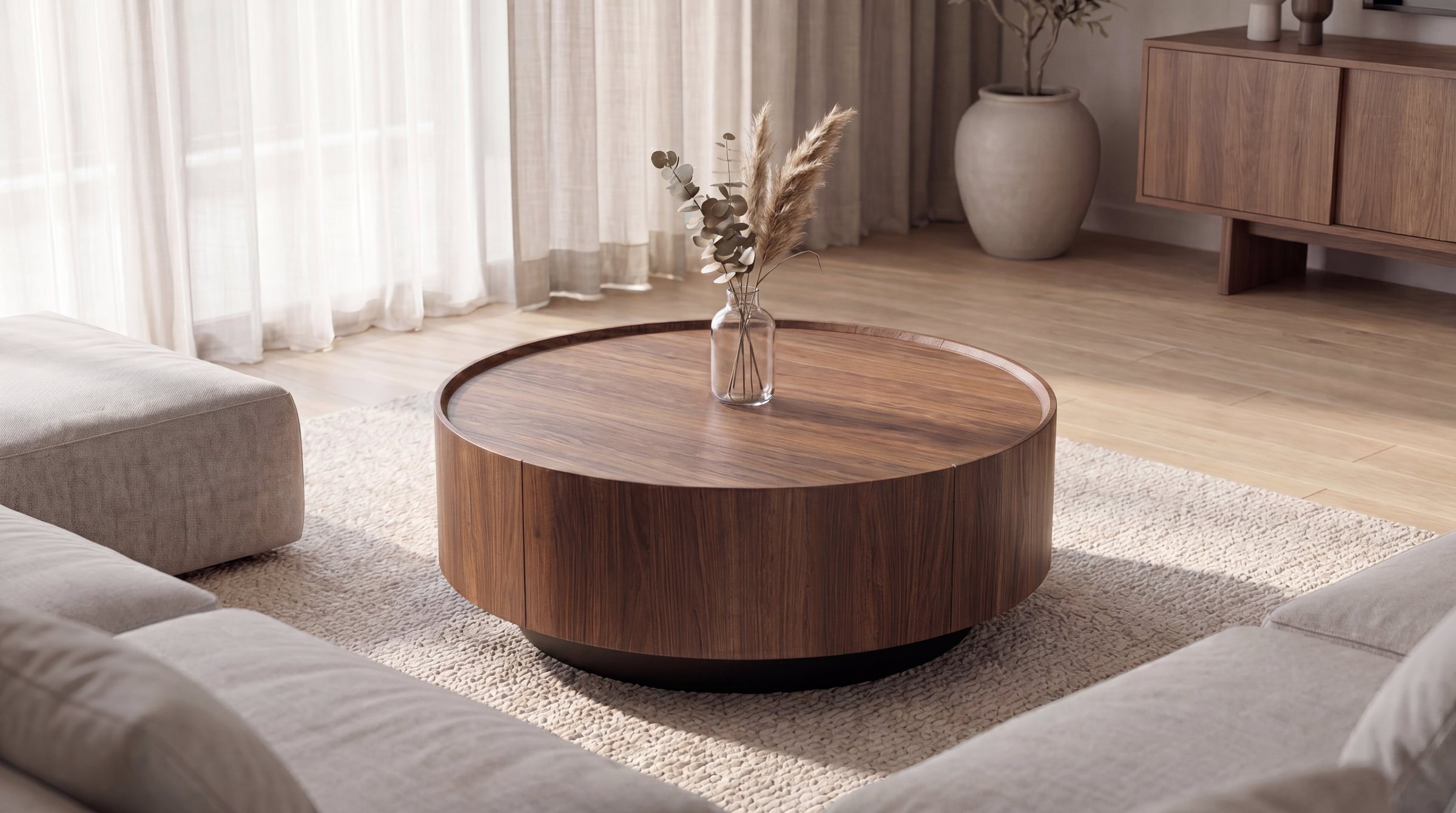
Search for coffee table sizing and most of what comes back is in inches, written for American living rooms with floor to spare. An HDB living room is a different brief. The sofa, the TV console and the walkway share a few square metres, and an extra 10 cm on a table can decide whether the room flows or feels cramped. Here's the same thinking in centimetres, for the two sofas most HDB homes choose between: the 3-seater and the L-shape.
Three rules of thumb, in centimetres
None of these are industry standards. They're proportions designers fall back on because they tend to look balanced, so treat them as a starting point and adjust for your room.
Length: about half to two-thirds of the sofa
Measure the seating part of your sofa (the cushions, not the arms) and aim for a coffee table between half and two-thirds of that length. Much shorter and the table looks lost in front of the sofa. Much longer and it starts to block the ends, so whoever sits there has to shuffle past it to get out.
If you only know the sofa's overall length, which is the figure most product pages list, the chart further down works from that. Sofas with chunky arms have less seating than their overall length suggests, so lean towards the lower end of each range.
Height: within a few centimetres of the seat
A coffee table is easiest to use when its top sits level with the sofa seat or a little below it, within a few centimetres either way. That keeps a cup within reach without leaning forward, and stops the table from visually cutting the sofa in half. Measure your sofa's seat height (floor to the top of the seat cushion) and work from that number.
Low, deep-seated sofas suit lower tables. A more upright sofa with a higher seat suits a taller one. Most of the coffee tables in our range sit between roughly 30 and 45 cm high, which covers both.
Distance: 40–60 cm from the sofa
Leave 40–60 cm between the front edge of the sofa and the edge of the table, depending on how you sit. Closer to 40 cm, you can reach a drink without getting up. Closer to 60 cm, longer legs have room to stretch out, and it's easier to stand up and step out.
That gap is for legroom, not traffic. If the space between sofa and table is also how people cross the room, it needs to be a proper walkway instead. Our furniture clearance guide for HDB flats covers walkway widths for the rest of the room.
Coffee table size chart by sofa length
Here's the length rule worked through for common sofa sizes. Every sofa on our sofas page lists its overall width for each size, in centimetres, so you can read straight across.
| Sofa length (overall) | Typical sofa | ½ to ⅔ of the length | Suggested table |
|---|---|---|---|
| 170 cm | 2-seater | 85–113 cm | 80–90 cm round, or 90–110 cm rectangular |
| 210 cm | 3-seater | 105–140 cm | 110–135 cm rectangular, or 90–100 cm round |
| 245 cm | Large 3-seater or compact L-shape | 123–163 cm | 120–150 cm |
| 270 cm | 4-seater or mid-size L-shape | 135–180 cm | 135–160 cm, or a nesting set |
| 310 cm | Large L-shape or sectional | 155–207 cm | 150–180 cm, or two tables side by side |
At the larger sizes we've stayed below the full two-thirds: a 200 cm table takes a lot of HDB floor, and two smaller tables are easier to walk around.
Sizing a coffee table for an L-shaped sofa
An L-shape changes the maths because people sit along two sides. Use the longer side for the length rule, then check the corner: the person tucked into the corner seat and the person at the end of the short side both need to reach the table.
This is where long rectangles struggle. A 140 cm rectangle centred on the long side often leaves the short side (the chaise or return) out of reach, and its corners point at the shins of anyone stepping into the L. If the far end of the short side still can't reach, a side table at that end usually solves it more neatly than a bigger coffee table.
Round vs rectangular coffee table
For most L-shaped sofas, a round table is the easier choice. It sits naturally in the crook of the L, every seat is roughly the same distance from it, and with no corners it's kinder to shins and small children. As a rule of thumb, an 80–100 cm round table suits a compact L-shape, while larger sectionals can take 100–120 cm or a pair of nesting rounds.
Rectangular tables still make sense in front of a straight 3-seater, where everyone faces the same way, and in front of a long L-shape whose short side is mostly a lounging chaise rather than extra seats.
| Round | Rectangular | |
|---|---|---|
| Works best with | L-shapes, sectionals and corners | Straight 2- and 3-seaters |
| Reach | Even from every seat | Best from the long side |
| Moving around it | No corners, so paths curve easily | Corners can catch shins in tight rooms |
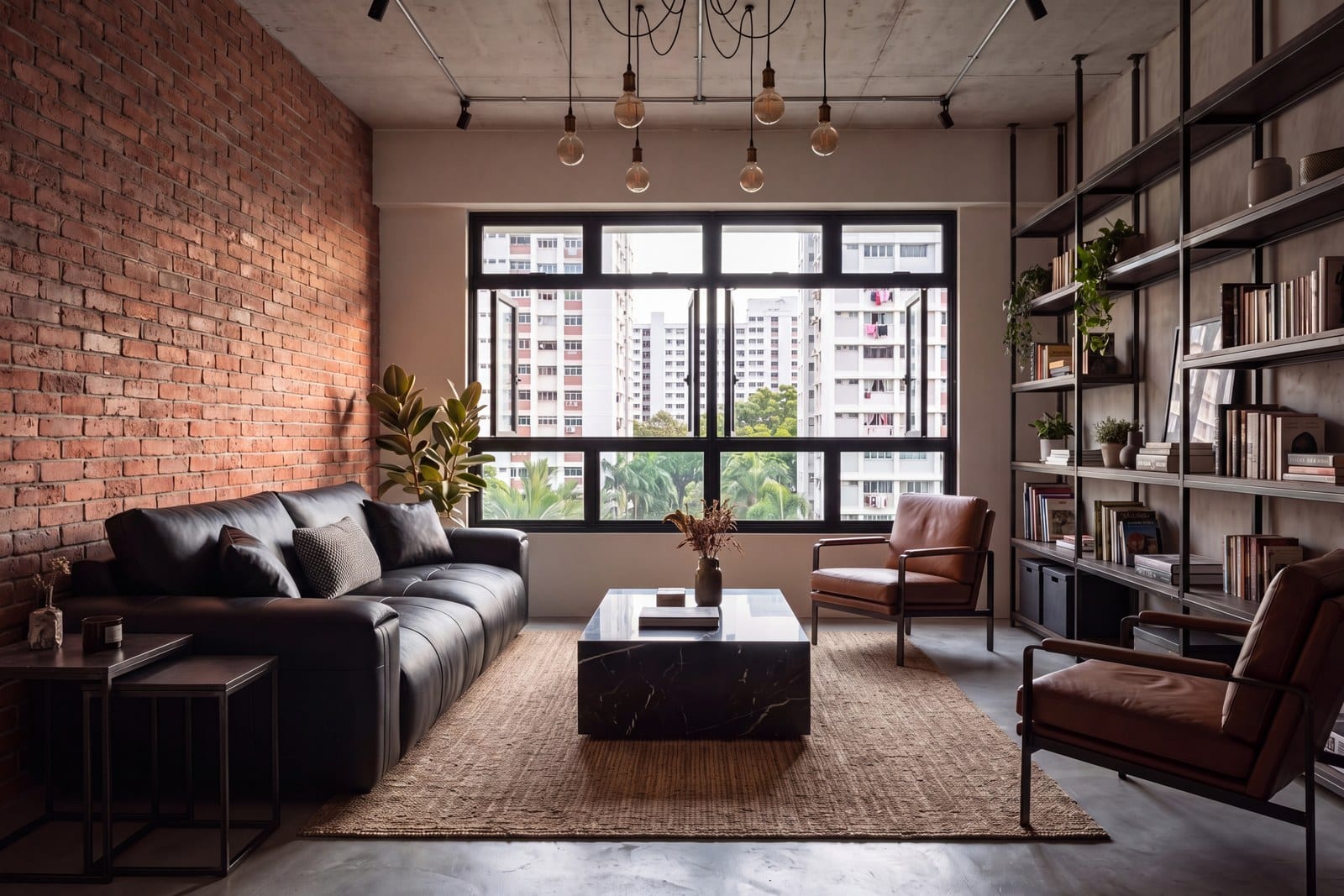
Tight living room? Consider nesting tables
When the floor between the sofa and the TV console is short, a nesting set (two or three tables of different heights that tuck into each other) is the most forgiving option. Keep them nested day to day for a smaller footprint, then pull one out beside the sofa or in front of a guest when you need more surface.
Smaller rounds help too. A 70–80 cm round table takes up noticeably less floor than a 120 cm rectangle, yet still reaches most seats on a compact sofa. If you're between two sizes, mark both outlines on the floor with painter's tape and live with them for a day or two before you decide.
Check the room's depth, not just the sofa
Before you settle on a size, add up everything that has to fit between the sofa wall and the TV wall: sofa depth, the 40–60 cm gap, table depth, a walkway, then the TV console. For example, a 100 cm-deep sofa, a 50 cm gap, a 60 cm-deep table, a 75 cm walkway and a 40 cm console come to 325 cm. If your living room is shallower than your total, choose a shallower table or a smaller round before you give up the walkway.
Vella coffee tables, with real measurements
A few pieces from our range that line up with the rules above. All dimensions are taken from the product pages at the time of writing.
- Aeris: a round wood-veneer table with two storage compartments, in 80, 90 or 100 cm across and 32 cm high. A natural fit in the crook of a compact L-shape, and its low height suits deeper, lower sofas.
- Saela: a rectangular ash wood table with a vintage matte black finish, 135 × 60 cm and 41 cm high. On the chart it suits sofas of roughly 210–245 cm, and its height works with more upright seats.
- Raren: a nesting set in microcrystalline stone on a solid wood base, 90 × 75 cm overall and 34 cm high. Nested, it's compact enough for a 2-seater or a tight living room; pull the pieces apart when guests come over.
- Momu: a two-piece sintered-stone table, 152 × 80 cm overall and 36 cm high. Sized for the long side of a 270–310 cm sofa, with the flexibility of two pieces.
Coffee table sizing: common questions
- What size coffee table do I need for an L-shaped sofa?
- As a rule of thumb, about half to two-thirds of the longer side's length, or an 80–100 cm round table for a compact L-shape. Check that the corner seat and the short side can both reach it.
- How far should a coffee table be from the sofa?
- Between 40 and 60 cm from the front edge of the sofa, depending on how you sit. If people walk through that gap, it needs to be a full walkway instead.
- How tall should a coffee table be?
- Within a few centimetres of your sofa's seat height, level with it or slightly lower. Measure from the floor to the top of the seat cushion.
- Is a round or rectangular coffee table better for an L-shaped sofa?
- Round usually works better, because it sits in the corner of the L and is roughly the same distance from every seat. Rectangles suit straight sofas where everyone faces the same way.
- What size coffee table suits a 3-seater sofa?
- For a 210 cm 3-seater, around 110–135 cm long for a rectangle, or 90–100 cm across for a round table.
- Are nesting coffee tables good for small HDB living rooms?
- Yes. They take up less floor when tucked together and give you extra surface when pulled apart.