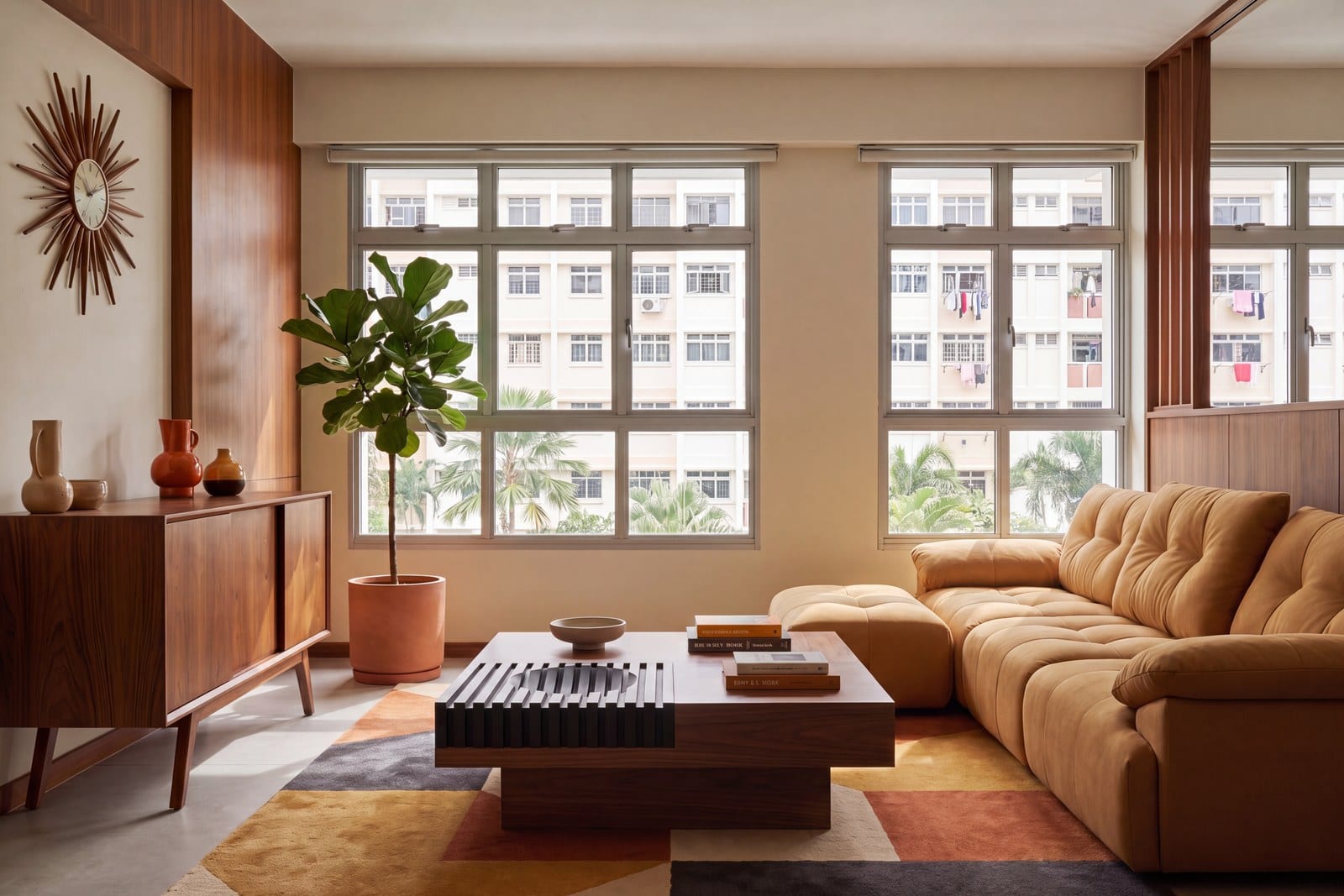
Most sofa decisions can be revisited. Cushions get swapped, throws change, the coffee table moves. The side of an L-shaped sofa's chaise is different: once it arrives, it's fixed to one side of your living room. In an HDB flat, where the main door, the windows, the TV wall and the walkway sit within a few metres of each other, the wrong side can block a path you use every day. Here's how to get it right before you order.
What left-facing and right-facing mean
The most common convention works like this: stand in front of the sofa and look at it, as if you were about to sit down. If the chaise (the extended seat) is on your left, it's a left-facing sofa, sometimes written LAF for "left arm facing". If it's on your right, it's right-facing, or RAF.
The catch is that not every seller uses the same reference point. Some describe the side as you'd experience it sitting on the sofa, which flips left and right. Treat the label as a starting point, not a guarantee.
Start with a quick floor plan
You don't need software. Sketch your living room from above on paper, roughly to scale, and mark:
- The main door, and the route you walk from it into the rest of the flat
- Windows, and any balcony or service yard door
- The TV wall, including where the TV point sits
- Structural columns, beams or wall protrusions near the corners
- The household shelter door, if it opens near the living or dining area
- Where the dining area starts, if the space is open-plan
Then draw the sofa both ways. One version usually looks obviously wrong once it's on paper. If you're still torn, mark both outlines on the floor with painter's tape. The chaise is the part people most often underestimate.
Six things in an HDB living room that decide the side
1. The main door and the walkway
In many HDB flats you walk from the main door straight through the living room, and that route carries everyone, every day, along with groceries, prams and deliveries. The chaise is the part of an L-shape that juts furthest into the room, so it should usually sit on the side away from that path. A chaise you have to step around on the way to the kitchen gets old quickly.
2. Windows, the balcony and the service yard
A chaise by the window makes a lovely daytime reading spot, but check that it doesn't stop a balcony or service yard door from opening fully, or block a window you need to reach. If that window gets strong afternoon sun, remember that long hours of direct sun can fade upholstery, so plan for curtains or blinds whichever side you choose.
3. The TV wall
The chaise brings the sofa closer to the TV wall on that side. Measure from the end of the chaise to the front of the TV console, and if people pass between them, keep a proper walkway there. If your TV point sits off-centre, a chaise on the same side as the screen usually gives the person lounging the straightest view, as long as that walkway survives.
4. Columns and wall protrusions
Many HDB living rooms have a structural column or a short wall protrusion in a corner or along a wall. It's easy to miss on a floor plan and impossible to miss when the sofa won't sit flush. Measure the clear wall length on each side of the corner you'll use, from the edge of the column rather than the corner itself, and check the sofa against those numbers.
5. The household shelter door
In many flats the household shelter opens near the living or dining area, and it often doubles as a storeroom, so it gets opened a lot. Keep the chaise out of the door's swing and leave an easy path for carrying things in and out.
6. The dining area in open-plan layouts
Where living and dining share one open space, the back of the sofa often becomes the divider between them. Decide whether the chaise end should point into the room or tuck against a wall, and keep the walkway between the sofa and the dining chairs clear. Dining chairs pull out further than you think.
| If your living room has… | Usually put the chaise… |
|---|---|
| The main door opening onto one side | On the opposite side, away from the entry path |
| A balcony or service yard door at one end | Away from that door, so it opens fully |
| An off-centre TV point | On the same side as the TV, if a walkway to the console remains |
| A column in one corner | Wherever the clear wall length fits the sofa, measured from the column's edge |
| The household shelter door nearby | Clear of the door's swing, with an easy path in and out |
| An open-plan dining area to one side | Where it won't narrow the walkway to the dining table |
Reversible and modular options
If your layout might change, whether through a move, a renovation or a new baby, look at sofas that don't lock the chaise to one side.
Reversible chaises
Some L-shaped sofas have a chaise that can be set up on either side. It's a genuinely useful feature, but it varies by design, so don't assume it from photos. Ask the seller directly whether a specific sofa is reversible and how it's done. If you're looking at one of ours, ask us before ordering.
Modular sofas
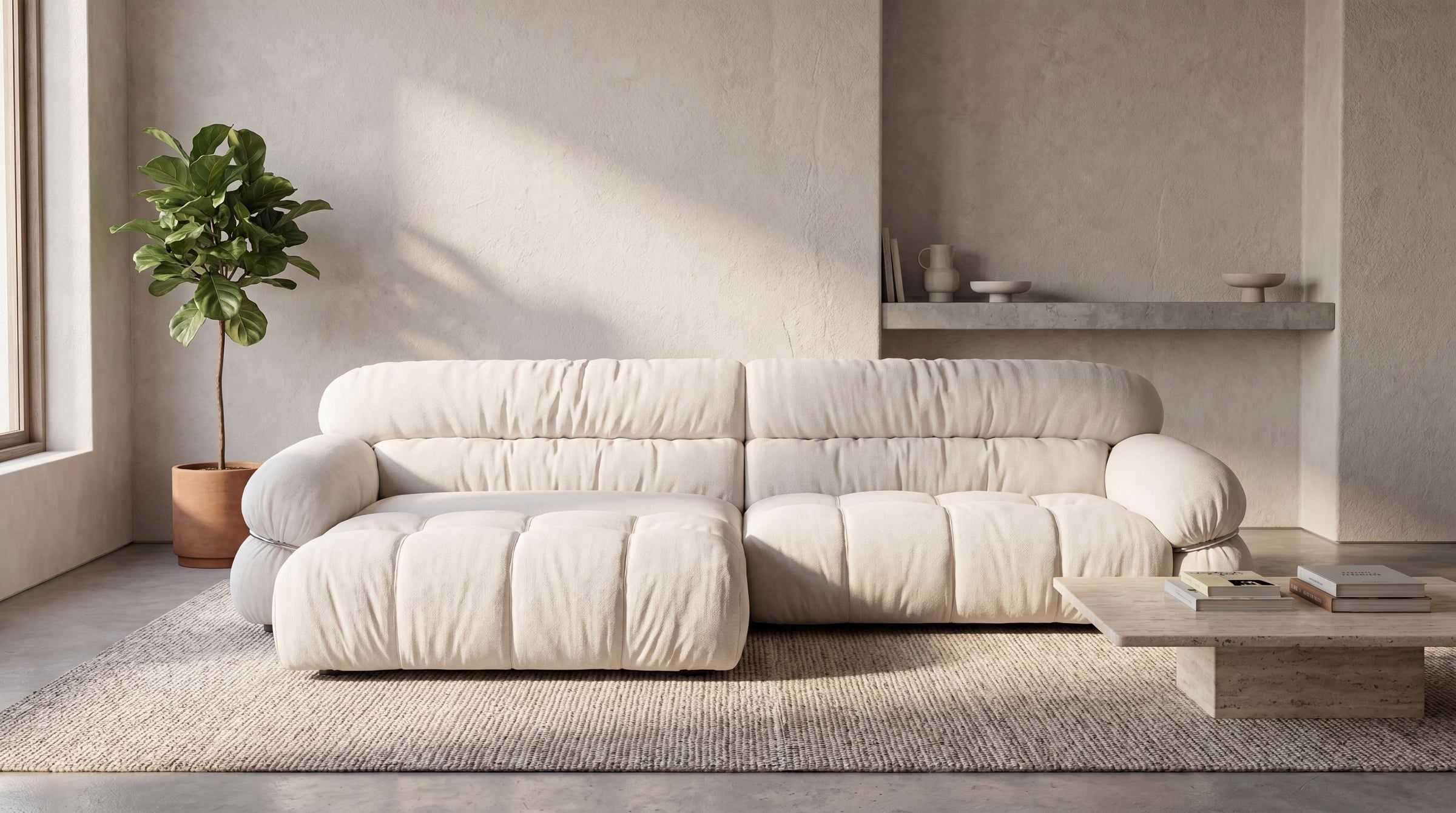
Modular sofas are built from separate units, which generally gives you more say over where the corner goes, and more freedom to rearrange later. Our Melin is made of individual units, each 105 × 105 cm with one seat and one backrest cushion, and comes as single units or a four-seater configuration. Configurations differ from design to design, so tell us the shape and side you have in mind and ask us to confirm it before you order.
A fixed chaise
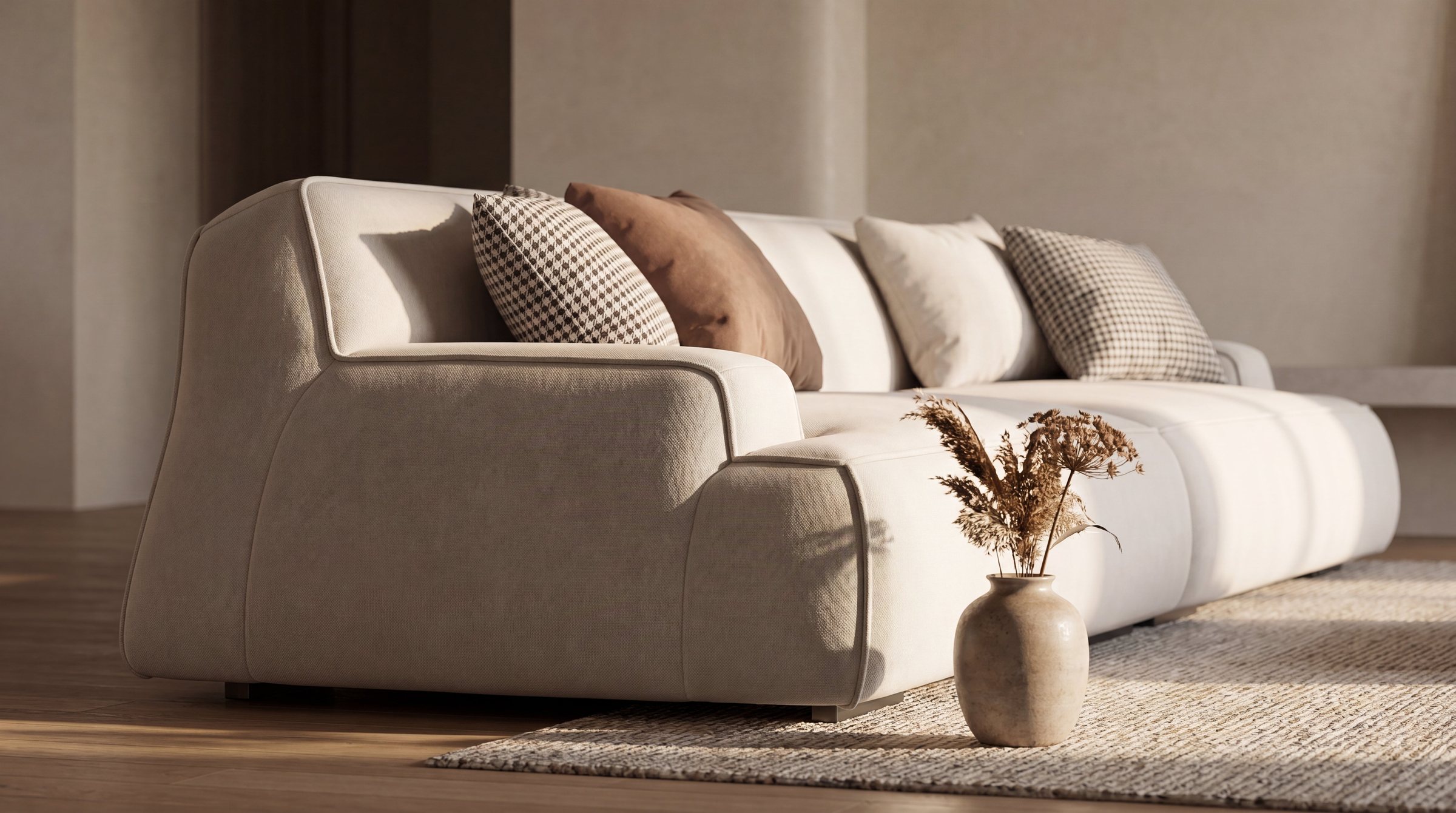
If you're sure of your layout, a fixed chaise gives you the most generous lounging spot. Our Volux is a 370 cm sofa with a chaise, upholstered in scratch-resistant fabric. At that length it suits a larger or open-plan living room better than a compact one. Ask us which side its chaise sits on before ordering.
Browse all sofas →Quick decision checklist
- Confirm what "left-facing" means with the seller, and ask for a top-down diagram.
- Sketch your living room and mark the doors, windows, TV wall, columns and shelter door.
- Draw the sofa both ways and rule out any version where the chaise crosses the main walkway.
- Check that the chaise doesn't block a balcony, service yard or shelter door.
- Measure from the end of the chaise to the TV console and keep a walkway if people pass.
- Measure clear wall lengths from the edge of any column, not from the corner.
- Check the delivery route for the sofa's largest piece. Our HDB lift measurement guide covers what to measure.
- If you're unsure, or your layout may change, look at modular options or ask us.
Once the chaise side is settled, size the table for the corner. Our coffee table size guide for L-shaped sofas has the measurements, or browse our coffee tables.
L-shaped sofa sides: common questions
- How do I know if an L-shaped sofa is left or right-facing?
- Stand in front of the sofa, facing it. If the chaise is on your left it's usually called left-facing, and on your right, right-facing, but naming varies, so confirm with the seller.
- What do LAF and RAF mean on a sofa?
- LAF means left arm facing and RAF means right arm facing. Each names the side the arm or chaise is on when you face the sofa.
- Which side should the chaise go on?
- Usually on the side away from your main walkway, where it won't block a balcony, service yard or shelter door.
- Can an L-shaped sofa be switched to the other side?
- Only if it's designed to be reversible or modular. Ask the seller before ordering rather than assuming.
- Does an L-shaped sofa fit an HDB living room?
- Often, yes, if the corner has enough clear wall on both sides and the chaise leaves a walkway. Measure from the edge of any column, not the corner.
- Is a modular sofa better than an L-shape for an HDB flat?
- If your layout might change, a modular sofa is more forgiving because its units can be rearranged. A fixed L-shape suits a layout you're sure of.